Monday, 11 August 2014

People in employment: 2012-2013 differential by London borough of residence

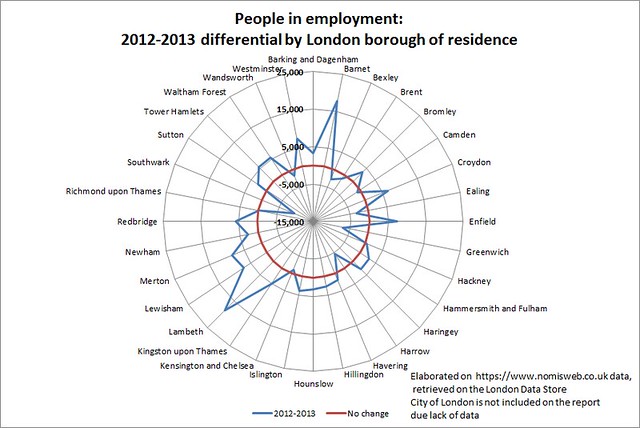
People living in Lambeth and Barnet appears to be sharing the lions' share of the recent surge in job creation in London:
People in employment 2012-2013 differential by London borough of residence
On the other hand Southwark and Greenwich didn't have a great job market year.

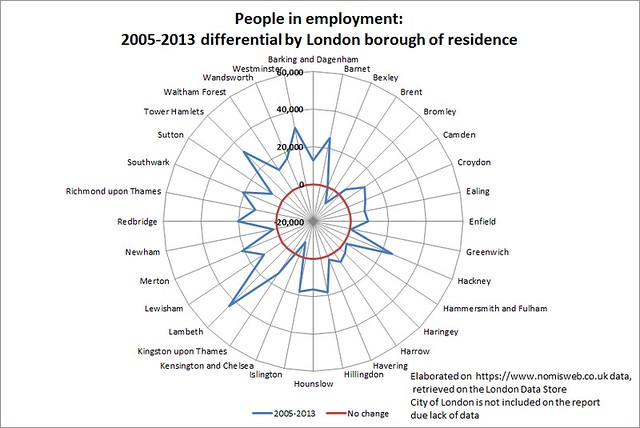
As a term of comparison, this is what happened in the last 8 years:
People in employment 2005-2013 differential by London borough of residence

Italian migration increase in London: which borough is seeing the greater impact?

On which borough are we noticing the greater impact of the recent increase of Italian migration in London?

The following chart is a proposed raw measure elaborated on https://www.nomisweb.co.uk data, retrieved from the London Data Store.

Impact of Italian first time workers on London job market by London borough of residence 2013-14

The measure is a raw one [1], and it doesn't have any other particular meaning than to show the impact those incoming Italians may have on the working population dynamics of a given borough.
To be absolutely clear, this doesn't show, actually cannot show, if Italians may be taking all new local jobs, or that they may be "stealing" jobs to people previously living on a particular borough, but it is more of measure of how much Italians tend or like to move in on a specific borough when they first enter the job market in London, in relation to that borough job market dynamics.

Italians may be pouring on Brent, but this may merely means that the decrease of the number of local active participants in the job market may be partially due local people finding better jobs and moving to other districts, as they are substituted by Italians (and perhaps other overseas workers) with lower job perspectives.

[1] it is basically a ratio of the number of NINo registered for the first time to people moving in UK from Italy to the number of job positions created by and for residents of a given borough in the given year, in case of job creation, or otherwise to the number of job position destroyed by and for residents of a given borough in the given year plus the number of NINo registered for the first time to people moving in UK from Italy, in case of job destruction, my Excel formula reads as:
=IF('2005-2013'!AW4 [less than] 0,(1+ABS('2013 Overseas Pressure'!C5/'2005-2013'!AW4))*100,(100*'2013 Overseas Pressure'!C5)/'2005-2013'!AW4)
This cannot show incoming Italians are taking all new jobs on a particular borough as the borough referred is the area of residence, not necessarily where they found their first job.
Friday, 8 August 2014

Where are Italians living when they start to work in London?

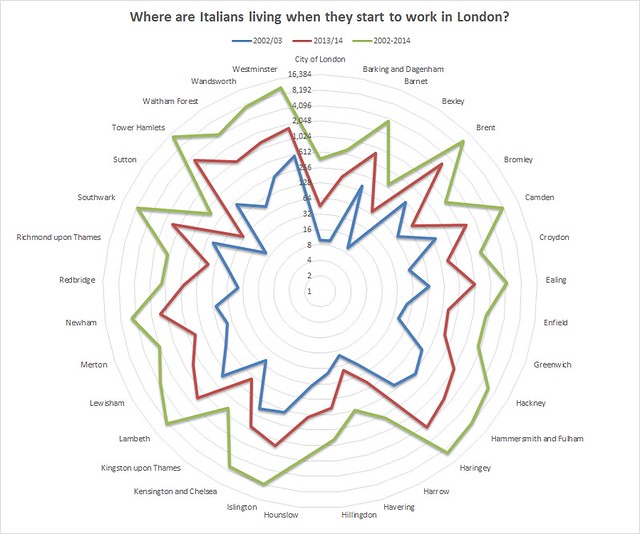
When they start to work in London after moving to the UK for the first time, Italians appear to like more some districts (i.e. Westminster) and to dislike some other (i.e. Havering).

The following chart should give a more complete view of the Italians' preferences:
Where are Italians living when they start to work in London

Please note the chart axis  is logarithmic, in base 2, so each larger circle is representing a doubling in population.

A tale of two boroughs: Italians landing in Kensington and Chelsea vs Tower Hamlets 2002 - 2014

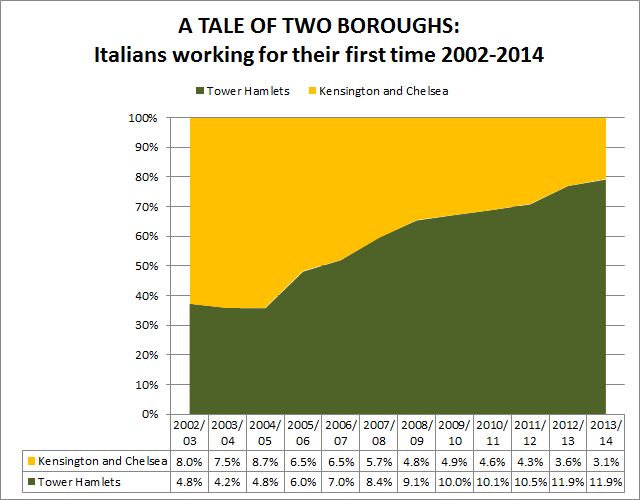
In absolute terms, the number of Italians being issued their first national insurance number (NINo) in Kensington and Chelsea more than doubled between the 2002/03 and the 2013/14 fiscal years.
On the other hand, while up to and including the 2004/05 fiscal year the Italians starting their London working life were landing in Kensington and Chelsea in almost twice the number of those landing in the less affluent borough of Tower Hamlets, since then the latter has seen an Italian invasion: in 2013/14 the number of Italians starting their working life in UK moving to Tower Hamlets has increased more than fifteenfold!
The following chart graphically describes the relative comparison between the two boroughs: Italians are clearly flocking to Tower Hamlets.
A Tale of two boroughs - Italians landings 2002 to 2014 - Kensington and Chelsea vs Tower Hamlets
While Tower Hamlets is less affluent than Kensington and Chelsea, its average income is still higher than the average income of more than half of Italy. Charts describing a very similar dynamics could be produced using Brent, Haringey or Lambeth in the place of Tower Hamlets, while the raise of Italian immigration to Newham or Waltham Forest appears to have picked up only in the last couple of years.

Tuesday, 5 August 2014

Where Italians go to live after landing in London?

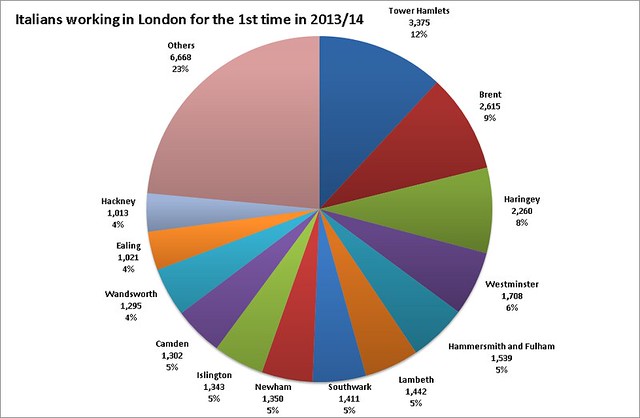
In which district are Italians living the very first time they start to work in London?

Italians working in London for the 1st time in 2013-14

Surprisingly, or may be not, Kensington and Merton are not even in the top 10.

Monday, 4 August 2014

The Italian invasion of London: 2013/14

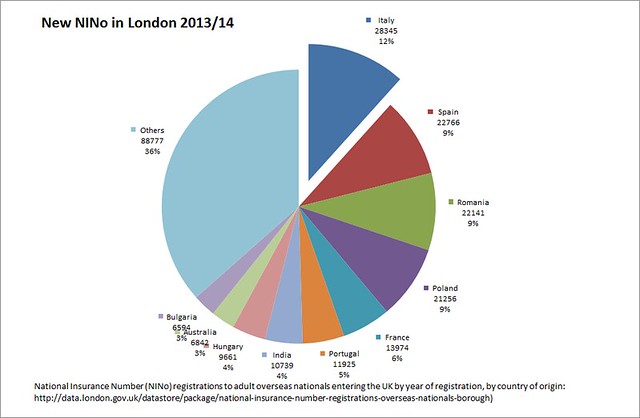
According to recently published data from the London Datastore, for the first time in the 12 years recorded in their dataset,  in 2013/14 Italy was the top country of origin for National Insurance Number (NINo) registrations to adult overseas nationals entering London.

In the 2013/14 fiscal year a stunning 12% of all new NINo registration of adult overseas nationals in London were accounted by Italians:
New NINo in London 2013-14

Please note this measure is possibly a very low estimation of immigration, as it doesn't take in account non working partners, children or other dependants that may migrate with the breadwinner. This is really as all the economically active inhabitants of one small Italian city, such as Ascoli Piceno or Mazara del Vallo or Rovigo, may have packed and moved in 12 months to London.

Update 2015 August 09
The London Datastore has moved the dataset used to build the diagram to a new location.

Friday, 30 May 2014

M5S vs PD 2013 - 2014

Gli effetti del Porcellum: nel 2014 il M5S ha preso quasi il 6% di seggi in piú rispetto al 2013, pur avendo perso in percentuale oltre il 4% di voti, mentre il PD, pur guadagnando oltre il 15% in voti, ha perso quasi il 5% in seggi:
M5S vs PD 2013-2014