Showing posts with label Italy. Show all posts

Wednesday, 12 July 2017

Triton, gli sbarchi e l'Italia

Qualche giorno fa ha fatto parecchio scalpore una intervista ad Emma Bonino, in cui l'ex ministro degli esteri italiano pare abbia affermato che "Siamo stati noi a chiedere che gli sbarchi avvenissero tutti in Italia, anche violando Dublino", ed anche "E nel 2014-2016 che il coordinatore fosse a Roma, alla Guardia Costiera e che gli sbarchi avvenissero tutti quanti in Italia, lo abbiamo chiesto noi, l’accordo l’abbiamo fatto noi, violando di fatto Dublino". La signora Bonino usa "noi", ma probabilmente per senso dello stato, perché il ministro degli esteri nel 2014 era un altro.
L'intervista ha causato molte reazioni. Dai commenti giunti da più parti, pare chiaro che fossero veramente in tanti, sia tra i comuni cittadini che nella classe politica, coloro i quali non avessero idea che una delle decisioni operative fosse proprio quella di scegliere i porti italiani per gli sbarchi.
Eppure sarebbe bastato chiedere a Frontex. E qualcuno lo ha fatto per noi. Non oggi o qualche giorno fa, ma già nell'Aprile del 2015 il Sig. Nicolai Christoffersen chiese a Frontex i piani operativi dell'operazione Triton, per quanto riguardava il 2014, e da Frontex gli rispose la Sig.ra Berenika Wyrzykowska, pubblicando tre documenti, il piano operativo, il manuale e gli allegati.
I documenti, come comprensibile, sono pieni di omissis, ma sul ruolo dell'Italia negli sbarchi non ci sono omissis, è tutto leggibile, pubblicamente, dal Maggio del 2015, Frontex non ha nemmeno pensato che queste informazioni potessero in alcun modo essere sensibili.
Ed hanno ragione, non sono informazioni sensibili dal punto di vista operativo. Ma potrebbero esserlo dal punto di vista politico.
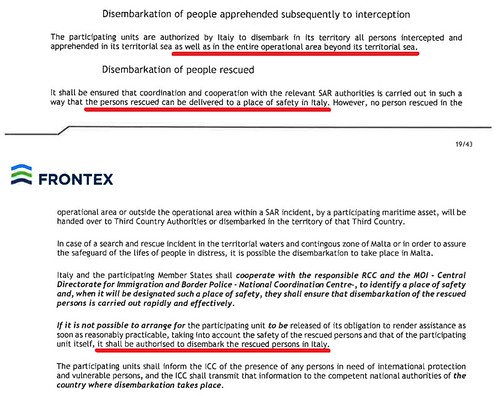
Chiunque abbia una confidenza con l'Inglese può leggere da se i tre documenti, qui un paio di assaggi, il primo sugli sbarchi:
Triton 2014 Annex 19-20
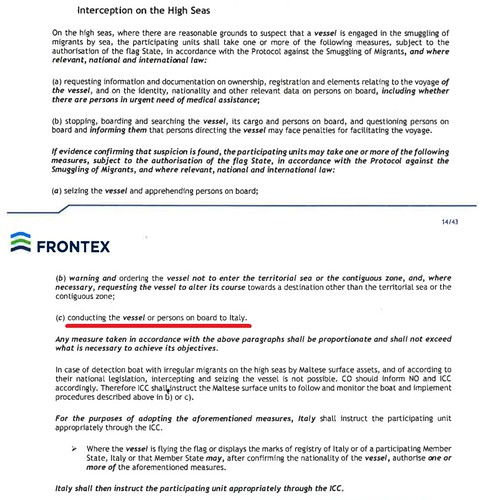
Il secondo sulle intercettazioni:
Triton 2014 Annex 13-14
Non credo ci sia molto altro da aggiungere.

Thursday, 13 October 2016

Excuse to discriminate Sicilian speakers?

Dear Sir or Madam,

I am a British citizen of Sicilian ancestry.

I have read with great personal happiness the recent news that school districts in England and Wales have started to include the Sicilian language and ethnicity in their enrolment forms.

The happiness was short lived, as after a day or two I read an article stating that "the Foreign Office in London has apologised" and that the forms "will be fixed":

http://www.ansa.it/english/news/general_news/2016/10/12/uk-apologises-for-school-forms-2_e3d72ec3-7346-4e8c-ac3b-cca7d9ad2fe9.html

Absolutely flabbergasted that the FCO would issues such an excuse, supinely accepting an imposition of a friendly but foreign country which will be felt as discriminatory by every speaker of the Sicilian language living in the UK, I have looked on the FCO website for the news item reporting such an action, but I could find none.

Could you please confirm that there was no excuse, and that the FCO will not impose the schools to "fix" the forms?

If indeed the FCO issued such an excuse, could you please refer me to the instructions on how to protest with the FCO for such a decision? Should I raise a FOI to understand how that was taken, and why the view of the Sicilian speakers living in the UK was not sought beforehand?

Kind regards,
Alessandro Riolo

Tuesday, 25 November 2014

University qualifications: Italy vs UK

The following table describes the equivalence among the Italian and British university qualifications as understood by myself at this point in time:


Please note in Italian universities the unit of credit, the Credito Formativo Universitario (CFU) is equivalent to the European Credit Transfer System (ECTS) unit, while in British universities two Credit Accumulation and Transfer Scheme (CATS) units are equivalent to one ECTS.

This explains why we need 180 CFU to gain a Laurea, and why that should be equivalent to the 360 CATS required for a Bachelor's Degree with Honours.

Some caveat:
  • In EU or EEA countries the only organizations who can officially confirm an academic equivalence is the local NARIC. 
  • The Italian NARIC or the British NARIC could have different ideas on how the respective university qualifications compare one each other, they may actually even have different ideas or understanding, the table above is based on my own understanding of the respective legal and qualification frameworks.
  • I am neither a solicitor, neither in any way related to any NARIC, so if you need an official statement, please go ask the specific NARIC, and if they don't agree with my understanding or with your expectations, tough luck.
  • You could make a case for the Master Universitario di 2° livello to be equivalent to a short Professional Doctorate, which unfortunately doesn't exist in the British qualification framework.
  • On the same note, I would probably equate a short (60 CFU) Diploma di Specializzazione di 2° livello to a Master of Philosophy with some study performed at level 8, or if the element of research was over 60 CFU, to a Research Master (MRes or MLitt), even though both these British qualifications are meant to be at level 7.


Friday, 8 August 2014

A tale of two boroughs: Italians landing in Kensington and Chelsea vs Tower Hamlets 2002 - 2014

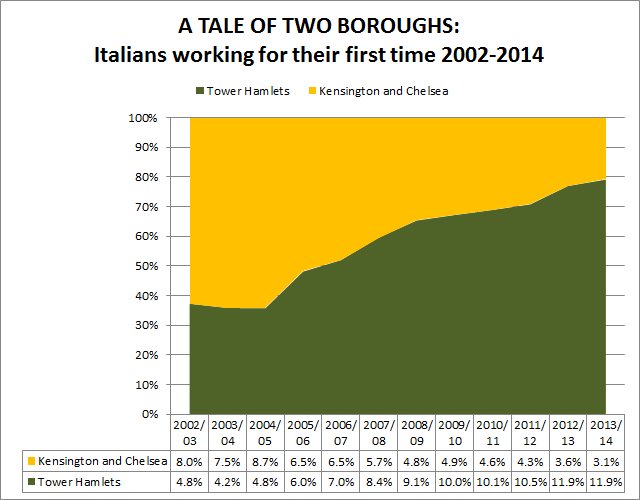
In absolute terms, the number of Italians being issued their first national insurance number (NINo) in Kensington and Chelsea more than doubled between the 2002/03 and the 2013/14 fiscal years.
On the other hand, while up to and including the 2004/05 fiscal year the Italians starting their London working life were landing in Kensington and Chelsea in almost twice the number of those landing in the less affluent borough of Tower Hamlets, since then the latter has seen an Italian invasion: in 2013/14 the number of Italians starting their working life in UK moving to Tower Hamlets has increased more than fifteenfold!
The following chart graphically describes the relative comparison between the two boroughs: Italians are clearly flocking to Tower Hamlets.
A Tale of two boroughs - Italians landings 2002 to 2014 - Kensington and Chelsea vs Tower Hamlets
While Tower Hamlets is less affluent than Kensington and Chelsea, its average income is still higher than the average income of more than half of Italy. Charts describing a very similar dynamics could be produced using Brent, Haringey or Lambeth in the place of Tower Hamlets, while the raise of Italian immigration to Newham or Waltham Forest appears to have picked up only in the last couple of years.

Tuesday, 5 August 2014

Where Italians go to live after landing in London?

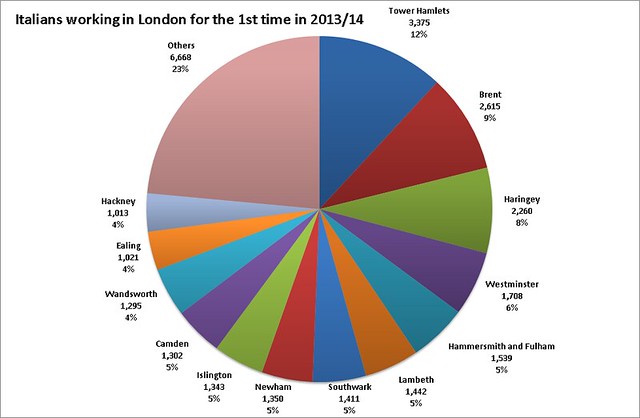
In which district are Italians living the very first time they start to work in London?

Italians working in London for the 1st time in 2013-14

Surprisingly, or may be not, Kensington and Merton are not even in the top 10.

Monday, 4 August 2014

The Italian invasion of London: 2013/14

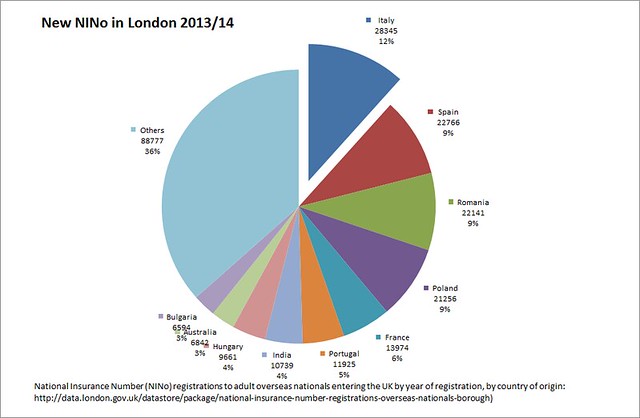
According to recently published data from the London Datastore, for the first time in the 12 years recorded in their dataset,  in 2013/14 Italy was the top country of origin for National Insurance Number (NINo) registrations to adult overseas nationals entering London.

In the 2013/14 fiscal year a stunning 12% of all new NINo registration of adult overseas nationals in London were accounted by Italians:
New NINo in London 2013-14

Please note this measure is possibly a very low estimation of immigration, as it doesn't take in account non working partners, children or other dependants that may migrate with the breadwinner. This is really as all the economically active inhabitants of one small Italian city, such as Ascoli Piceno or Mazara del Vallo or Rovigo, may have packed and moved in 12 months to London.

Update 2015 August 09
The London Datastore has moved the dataset used to build the diagram to a new location.

Sunday, 16 June 2013

Comment to Khalil Al-Anani's Turkey’s uprising is beyond the Islamists

Comment to Khalil Al-Anani's Turkey’s uprising is beyond the Islamists, published Thursday 13 June 2013 on Arhamonline

Hi Khalil, I wrote an opinion piece a couple of days ago in Italian, totally indipendently from yours, which I just read, but which was reaching very similar conclusions. It is in Italian, this is a link to the article: http://istanbulavrupa.wordpress.com/2013/06/15/tayyippuccio-scelebano-e-parricidi-tayyippisti-di-alessandro-riolo/ I start with a parallel between the 12th year of rule of the Christian Democrats in Italy, 1958, when they lost the control of the streets and sent their police to shot protesting people in the streets. The spark of that revolt was very different, but the causes are much more similar, during a susteined economic growth a great minority of people thought, rightly, that the government was ruling against them, and had lost hope to influence the government through the ballots. The effects in the Italian history were monumental, in the next couple of years after the revolt the christian democrats changed their policies, mitigated their authoritarian attitudes relegating to the fringe their more conservative wing, and presieded over a huge economic leap forward in the '60s. Later I talk about RTE, and compare him with Mrs. Thatcher, and I close the article asking if the AKP will be able to perform what the CHP was never able to do, a political ritual parricide, replacing RTE with someone more amenable a less authoritarian way to rule the country.

Caveat: I do use a few untranslatable word plays, i.e. Mr. Scelba was the Italian christian democrat who in the '50s gave the Italian police its pro-conservative character, so Scelbano is someone who's following or liking its authoritarian policies, a word which I modified in Scelebano to resonate with Talebano, the Italian version of Taliban. Tayyippuccio is the somewhat affectionate diminuitive I do often use when referring to Mr. Erdoğan, and the Tayyippisti are its followers (again, the word in Italian resonates with Teppisti, that's it hooligans or thugs)

Wednesday, 4 November 2009

Some confusion about crucifixes

In response to Manuela Mesco's Italians reject crucifix ruling:

Dear Manuela Mesco,

I am afraid but I have to side with whatithink's comment, you haven't checked the facts and your article shouldn't have been allowed out before further improvements.

The original Lateran Treaty is from 1929, but they have been revised in 1984, and the current law regarding the relationship between the Republic of Italy and the Catholic Church is from 1985 ("Legge 25 marzo 1985, n. 121"). The crucifix anyway didn't enter in the Italian school due the 1929 Lateran Treaty, but through a simple ministerial memorandum from 1922, which was then confirmed by a proper law in 1924.
You may read further about this in an article (in Italian) of the Avv. Antonino Ciavola (a careful reader will notice that the ministerial memorandum was issued 6 days after Mr. Mussolini was elected PM).

The "European Court" term is used mostly to indicate the Curia, or, as it is mostly known in English, the European Court of Justice (in Italian the "Corte di giustizia delle Comunità europee"), which shouldn't be confused with the European Court of Human Rights (in Italian "Corte Europea dei diritti dell'uomo"). The sentence object of your article was emitted by the latter, which is not an Europe Union institution.

This is only the most recent episode of a saga about the use of the crucifix on public spaces which has been ongoing in Italy since 1985. You should have mentioned some of that, to give a context to your readers. Many Italian courts have ruled that being the Catholic Church not anymore the State religion, the crucifix is not anymore a requirement, . Using "Adel Smith" as a keyword may help you find more about this.

Hope this helps,

Wednesday, 27 August 2008

Confusion about EU Directive

[Lady Sarah Ludford is one of the MEPs of the London constituency, where I reside. For various reasons, mostly my voting patterns, I regard her as my MEP]

To Lady Sarah Ludford,
to Lady Sarah Ludford's office,

My wife and I we have an issue with some truly unexpected side effect
of the implementation of an EU Directive, the 2004/38/EC.

Please read the attached document,

kind regards,
Alessandro Riolo

Dear Lady Sarah Ludford,

I am an Italian citizen, living and working in London since slightly less than 3 years, therefore I have yet to vote for the European Parliament elections in a British constituency, anyway as in the last local elections I participated I voted primarily for the LDP candidates, I would like to ask you to let me to regard yourself as my own MEP.

I have an issue with some truly unexpected side effect of the implementation of an EU Directive, the 2004/38/EC.

Introduction

In this letter I will present the matter two times, first as a short story, then as a longer and more meticulous account. I believe my tale would have intrigued Kafka, and although I understand the need for concision, which I am going to fulfil with the shorter version, I feel necessary to retell it on its full breadth.

At the end of both narratives I have some personal requests for you.

The short story

My wife of 15 months is a Turkish citizen, legally residing in the United Kingdom since 10 months and a holder of a Residence Card for Family members of EEA citizens, valid for the next 5 years.

The Italian Consulate in London has refused to provide my wife with a Schengen visa to travel into the EU. They motivated their decision with the fact that Italy has implemented the EU directive 2004/38/EC, which should provide for freedom of movement for family members of EU citizens inside the EU, therefore now they are refusing to provide visas to EU citizens’ spouses holding a British Residence Card.

As my wife’s next travel should be in Spain, the Spanish consulate instead sadly told us that the British Residence Card is worthless as a visa, and that the Italian consulate should provide my wife with a visa.

The Italian Consulate retorted that they have their hands tied, this is some Italian Government’s authority decision, and that although aware of the issue, the only thing they can do is notifying the Spaniards of the issue.

This so far led us to a huge disservice, as being an Italian citizen I was expecting the Italian consulate to provide my wife with a visa in 24 hours of less, while the Spaniards can’t care less about me or my wife, and vaguely promised to end the visa process application in 6 weeks or some more.

Also, given that main destination country of my wife’s travels on any foreseeable period of time will be Italy, this may lead Spain to refuse to provide a visa to my wife, if not this time the next time she would need one.

The meticulous account

My wife is a Turkish citizen. We have been dating for more than 8 years, and we are married for 15 months. Since 10 months my wife is living in the United Kingdom thanks to a Residence Card for Family members of EEA citizens. This Residence Card will be valid for next 5 years.

Italian consulates around the world are supposed, due an Italian law, to provide Schengen visas to spouses of Italian citizens for free and giving priority to their requests. As per our own experience, it took the Consulate of Istanbul less than 24 hours to provide my wife with a multiple entrance type C Schengen visa valid for 1 year. At that time, they clearly stated to us that next year they would have provided my wife with a multiple entrance type C Schengen visa valid for more than 1 year (C2, C3 or C5).

This visa has now expired since a few months, and because my wife is now a lawful resident of the United Kingdom, we went to ask another visa to the Italian Consulate in London.

It was one of the greatest surprises of my life that they refused my wife a visa. Their point was that because my wife is now officially resident in an EU country and she has a British Residence Card, she should be able to travel at will inside the EU without the need of a visa.

This is looking great on paper, but sadly it is not true. My wife needed to travel in Spain, so we went to the Spanish Consulate to verify their viewpoint, and as we had feared, the Spaniards told us they regard the British Residence Card completely worthless as a visa, and that because I am an Italian citizen, we should be provided a Schengen visa from the Italian consulate.

Back at the Italian consulate, I had a very kind phone conversation with the Italian consul herself, who told me she was aware of the issue, but they had received precise orders by the Italian government not to issue visas to EU citizens’ spouses holding a British Residence Card. I asked her to tell me which law and which authority was exactly forbidding my wife to get a visa, she could not give me an exact reference at the moment, but in her answer she clearly stated it was due the implementation of the EU directive 2004/38/EC.

I couldn’t believe my ears. I have read that directive, and I know that it is supposed to improve the freedom of movement of EU citizens and their immediate family, not to restrict the concession of visas for the spouses of EU citizens.

Anyway, given that it was exceedingly obvious also from her apologetical tone that she had her hands tied, and after she told me we weren’t the only couple sharing this very same problem, that she had already voiced her concerns about this matter to the Italian government and that she was going to call the Spaniards to make them aware of the issue, I thanked her and I left the Italian consulate.

With my wife, we went to the Spanish consulate, we filled all the required forms and we gave them the various photocopies they asked us, and then they told us it will took them 2 weeks to send us an invitation to an interview, and afterwards it may took 4 weeks to get an answer on the concession of a visa.

As everyone may see, this is a far cry from the 24 hour we had expected to wait from the Italian consulate, and surely the Spaniards will not provide my wife with the multi-annual type C we were lead to believe we would have got.

Fascinatingly, this is also posing a conundrum: as everyone who has dealt with the Schengen visa application process knows, the application should be done to the consulate of the main destination country of the applicant’s travels, but in the case of my wife, given that the main destination of our travels in any length of time will surely be Italy, and that Italy would not give her a visa, it would also means that as long as my wife is not an EU citizen but is a legally acknowledged EU resident, she would never get a visa, and the only EU countries she could legally travel into would be Italy and the United Kingdom.

To solve this Gordian knot we had to write in the application for the visa that the main destination for my wife’s European travels is Spain, which is a very tenuous assertion at best.

Request

I had the idea to write to you after applying for help to the Italian Solvit centre.

In their complaint form they were asking who I tried to contact to solve the issue. At that point I had only contacts with the Italian and the Spanish consulates, and desolately the consulates, in part for their own nature, are between the governmental agencies probably one the most removed from the taxpayers which are backing them.

As the issue at stake here is a basic pillar of the EU structure, the freedom of movement, I felt I had to try to contact the political arm of the EU.

I am not sure how much power, time and will a MEP has to deal with a case like this, but I would like you to appreciate that in this story my wife and I we are like two small terracotta pots between two very big iron vases. Any help, advise or even some simple suggestion would be greatly appreciated.

Although at this point I don’t have the precise references of which exact law or regulation or simple burocratic decision is forbidding the Italian consulates to provide my wife or any other EU citizen’s wife holding a British Residence Card with a visa, I can’t stop to think that it is completely paradoxical that my wife’s right to free movement inside the EU should be restricted by a truly short-sighted interpretation of the implementation of the very same EU directive that should enforce that very same freedom of movement.

Yours Sincerely,

Alessandro Riolo

Post Scriptum:

I may probably send to the some selected English media a slightly re-worked version of the longer account I gave you. As they are usually quite cold on EU related matters as such, I may try to warm up their interest adding some other details which are not really adding anything to the matter at stake, but that should give me some chance to attract their attention. If that will be the case, I will provide you with that version as well.