Now the Greeks, being thus besieged by land and by sea, knew not what to do, since they had neither ships nor allies nor provisions; and they thought that there was no way out, save only to suffer the pains which they had themselves inflicted, not in retaliation, but in wantonness and unjustly upon the people of small states, for no other single reason than because they were in alliance with the Germans.
On this account they restored to the disfranchised their political rights and held out steadfastly, refusing to make overtures for peace even though many were dying in the country from starvation. When, however, their provisions had entirely given out, they sent ambassadors to Schäuble declaring their wish to become allies of the Germans while still keeping their banks, their infrastructures, the luxurious pensions and the Euro, and on these terms to conclude a treaty.
But Schäuble bade them go to the Eurozone leaders, saying that he himself had no authority. And when the ambassadors reported to the Greeks this reply, they sent them to the Eurozone leaders.
But when they were at Brussels, near Germany, and the Eurogroup finance ministers learned from them what proposals they were bringing,—the same, namely, as those which they had presented to Schäuble,—they directed them to go back again without coming a step farther and, if they really had any desire for peace, to take better counsel before they returned.
And when the ambassadors reached home and reported this to the people, despondency descended upon all; for they imagined that they would be reduced to slavery, and that while they were sending another set of ambassadors, many would die of the famine.
Nevertheless, no one wanted to make any proposal involving the destruction of the banks or the sale of infrastructure; for when Samaras said in the Senate that it was best to make peace with the Germans on the terms they offered—and the terms were that they should sell some infrastructures and cut the pensions to decrease the public debt,—he was thrown into prison, and a decree was passed forbidding the making of a proposal of this sort.
This being the condition of affairs in Greece, Tsipras said in the Assembly that if they were willing to send him to the Merkel, he would find out before he came back whether the Germans were insistent in the matter of the pensions because they wished to reduce the country to slavery, or in order to obtain a guarantee of good faith. Upon being sent, however, he stayed with Merkel three months and more, waiting for the time when, on account of the failure of provisions, the Greeks would agree to anything and everything which might be proposed.
And when he returned in the fourth month, he reported in the Assembly that Merkel had detained him all this time and had then directed him to go to Brussels, saying that he had no authority in the matters concerning which Tsipras asked for information, but only the Eurogroup finance ministers. After this Tsipras was chosen ambassador to Brussels with full power, being at the head of an embassy of ten.
Merkel meanwhile sent Draghi, an Italian exile, in company with some Germans, to report to the Eurogroup finance ministers that the answer he had made to Tsipras was that she only had authority in the matter of peace and war.
Now when Tsipras and the other ambassadors were at the Eurozone leaders and, on being asked with what proposals they had come, replied that they had full power to treat for peace, the Eurogroup finance ministers thereupon gave orders to summon them to Germany. When they arrived, the Eurogroup finance ministers called an assembly, at which the Finns and Slovaks in particular, though many other Europeans agreed with them, opposed making a treaty with the Greeks and favoured destroying their country.
The Germans, however, said that they would not enslave a European country which had done great service amid the greatest perils that had befallen Europe, and they offered to make peace on these conditions: that the Greeks should destroy the big banks and leave the Euro, surrender all their infrastructures except twelve, allow their exiles to return, count the same people friends and enemies as the Germans did, and follow the Germans both by land and by sea wherever they should lead the way.
So Tsipras and his fellow-ambassadors brought back this word to Greece. And as they were entering the country, a great crowd gathered around them, fearful that they had returned unsuccessful; for it was no longer possible to delay, on account of the number who were dying of the famine.
On the next day the ambassadors reported to the Assembly the terms on which the Germans offered to make peace; Tsipras acted as spokesman for the embassy, and urged that it was best to obey the Germans and tear down the expensive pensions. And while some spoke in opposition to him, a far greater number supported him, and it was voted to accept the peace.
After this Merkel came to Greece, the exiles returned, and the Europeans with great enthusiasm began to tear down the expensive pensions to the music of flute-girls, thinking that that day was the beginning of freedom for Europe.
http://ale.riolo.co.uk/2015/07/pseudoxenophon-pseudohellenica-2210-23.htmlThis work, "Pseudoxenophon
pseudohellenica 2.2.10-23", is a derivative of "Xenophon, Hellenica, Carleton
L. Brownson, Ed.", Perseus (http://www.perseus.tufts.edu),
used under CC BY-SA 3.0 US.This derivative work "Pseudoxenophon
pseudohellenica 2.2.10-23" is licensed under the same “Creative Commons
Attribution-ShareAlike 3.0 United States License” (http://creativecommons.org/licenses/by-sa/3.0/us/)
by Alessandro Riolo (http://ale.riolo.co.uk).
Showing posts with label Greece. Show all posts
Showing posts with label Greece. Show all posts
Thursday, 16 July 2015


Pseudoxenophon pseudohellenica 2.2.10-23
οἱ δ᾽ Ἕλληνες πολιορκούμενοι κατὰ γῆν καὶ κατὰ θάλατταν ἠπόρουν τί χρὴ ποιεῖν, οὔτε νεῶν οὔτε συμμάχων αὐτοῖς ὄντων οὔτε σίτου: ἐνόμιζον δὲ οὐδεμίαν εἶναι σωτηρίαν †εἰ μὴ παθεῖν ἃ οὐ τιμωρούμενοι ἐποίησαν, ἀλλὰ διὰ τὴν ὕβριν ἠδίκουν ἀνθρώπους μικροπολίτας οὐδ᾽ ἐπὶ μιᾷ αἰτίᾳ ἑτέρᾳ ἢ ὅτι ἐκείνοις συνεμάχουν.
διὰ ταῦτα τοὺς ἀτίμους ἐπιτίμους ποιήσαντες ἐκαρτέρουν, καὶ ἀποθνῃσκόντων ἐν τῇ χώρᾳ λιμῷ πολλῶν οὐ διελέγοντο περὶ διαλλαγῆς. ἐπεὶ δὲ παντελῶς ἤδη ὁ σῖτος ἐπελελοίπει, ἔπεμψαν πρέσβεις παρα Σόιβλεαν, βουλόμενοι σύμμαχοι εἶναι Γερμανοίςἔχοντες οι τράπεζες, οι ὑποδομές, οι πολυτελείς συντάξεις καὶ τὸν Ευρών, καὶ ἐπὶ τούτοις συνθήκας ποιεῖσθαι.
ὁ δὲ αὐτοὺς εἰς τοὺς ἡγέτες της Ἐυρωζώνης ἐκέλευεν ἰέναι: οὐ γὰρ εἶναι κύριος αὐτός. ἐπεὶ δ᾽ ἀπήγγειλαν οἱ πρέσβεις ταῦτα τοῖς Ἕλλησῐν, ἔπεμψαν αὐτοὺς εἰς τοὺς ἡγέτες της Ἐυρωζώνης.
οἱ δ᾽ ἐπεὶ ἦσαν ἐν Βρυξέλλσίν πλησίον τῆς Γερμανίας καὶ ἐπύθοντο της Ἐυρωομάδας οἱ ὑπουργόι Ὀικονομικών αὐτῶν ἃ ἔλεγον, ὄντα οἷάπερ καὶ πρὸς Σόιβλεαν, αὐτόθεν αὐτοὺς ἐκέλευον ἀπιέναι, καὶ εἴ τι δέονται εἰρήνης, κάλλιον ἥκειν βουλευσαμένους.
οἱ δὲ πρέσβεις ἐπεὶ ἧκον οἴκαδε καὶ ἀπήγγειλαν ταῦτα εἰς τὴν πόλιν, ἀθυμία ἐνέπεσε πᾶσιν: ᾤοντο γὰρ ἀνδραποδισθήσεσθαι, καὶ ἕως ἂν πέμπωσιν ἑτέρους πρέσβεις, πολλοὺς τῷ λιμῷ ἀπολεῖσθαι.
περὶ δὲ η πώληση των ὑποδομών ή των τραπεζών τῆς καθαιρέσεως οὐδεὶς ἐβούλετο συμβουλεύειν: Σαμαράς γὰρ εἰπὼν ἐν τῇ βουλῇ Γερμανοίς κράτιστον εἶναι ἐφ᾽ οἷς προυκαλοῦντο εἰρήνην ποιεῖσθαι, ἐδέθη: προυκαλοῦντο δὲ ὑποδομές πωλούν και τις συντάξεις ἀποκοπή για μειούμαι το δημόσιο χρέος: ἐγένετο δὲ ψήφισμα μὴ ἐξεῖναι περὶ τούτων συμβουλεύειν.
τοιούτων δὲ ὄντων Τσίπρας εἶπεν ἐν ἐκκλησίᾳ ὅτι εἰ βούλονται αὐτὸν πέμψαι παρὰ Μέρκελαν, εἰδὼς ἥξει Γερμανούς πότερον ἐξανδραποδίσασθαι τὴν χώραν βουλόμενοι ἀντέχουσι περὶ τῶν συνταξεῶν ἢ πίστεως ἕνεκα. πεμφθεὶς δὲ διέτριβε παρὰ Μέρκελᾳ τρεῖς μῆνας καὶ πλείω, ἐπιτηρῶν ὁπότε Ἕλληνες ἔμελλον διὰ τὸ ἐπιλελοιπέναι τὸν σῖτον ἅπαντα ὅ τι τις λέγοι ὁμολογήσειν.
ἐπεὶ δὲ ἧκε τετάρτῳ μηνί, ἀπήγγειλεν ἐν ἐκκλησίᾳ ὅτι αὐτὸν Μέρκελα τέως μὲν κατέχοι, εἶτα κελεύοι εἰς τοὺς ἡγέτες της Ἐυρωζώνης ἰέναι: οὐ γὰρ εἶναι κύριος ὧν ἐρωτῷτο ὑπ᾽ αὐτοῦ, ἀλλὰ της Ἐυρωομάδας τοὺς ὑπουργοὺς Ὀικονομικών. μετὰ ταῦτα ᾑρέθη πρεσβευτὴς εἰς Λακεδαίμονα αὐτοκράτωρ δέκατος αὐτός.
Μέρκελα δὲ της Ἐυρωομάδας τοῖς ὑπουργόις Ὀικονομικών ἔπεμψεν ἀγγελοῦντα μετ᾽ ἄλλων Γερμανῶν Ντράγκοις, φυγάδα Ἰταληκὸν ὄντα, ὅτι ἀποκρίναιτο Τσίπρᾳ ἐκείνους κυρίους εἶναι εἰρήνης καὶ πολέμου.
Τσίπρας δὲ καὶ οἱ ἄλλοι πρέσβεις ἐπεὶ ἦσαν ἐν Βρυξέλλσίν, ἐρωτώμενοι δὲ ἐπὶ τίνι λόγῳ ἥκοιεν εἶπον ὅτι αὐτοκράτορες περὶ εἰρήνης, μετὰ ταῦτα της Ἐυρωομάδας οἱ ὑπουργόι Ὀικονομικών καλεῖν ἐκέλευον αὐτούς. ἐπεὶ δ᾽ ἧκον, ἐκκλησίαν ἐποίησαν, ἐν ᾗ ἀντέλεγον Φίννοι καὶ Σλοβάκοι μάλιστα, πολλοὶ δὲ καὶ ἄλλοι τῶν Ἐυρωπαίων, μὴ σπένδεσθαι Ἕλλησῐν, ἀλλ᾽ ἐξαιρεῖν.
Γερμανοί δὲ οὐκ ἔφασαν χώραν Ἐυρωπαίδα ἀνδραποδιεῖν μέγα ἀγαθὸν εἰργασμένην ἐν τοῖς μεγίστοις κινδύνοις γενομένοις τῇ Ἐὐρώπῃ, ἀλλ᾽ ἐποιοῦντο εἰρήνην ἐφ᾽ ᾧ τά τε μακρὰ συντάξεις καθελόντας καὶ τὸν Ευρών αφήνοντας καὶ τὰς ὑποδομές πλὴν δώδεκα παραδόντας καὶ τοὺς φυγάδας καθέντας τὸν αὐτὸν ἐχθρὸν καὶ φίλον νομίζοντας Γερμανοίς ἕπεσθαι καὶ κατὰ γῆν καὶ κατὰ θάλατταν ὅποι ἂν ἡγῶνται.
Τσίπρας δὲ καὶ οἱ σὺν αὐτῷ πρέσβεις ἐπανέφερον ταῦτα εἰς τὴν Ἑλλάδα. εἰσιόντας δ᾽ αὐτοὺς ὄχλος περιεχεῖτο χώρα, φοβούμενοι μὴ ἄπρακτοι ἥκοιεν: οὐ γὰρ ἔτι ἐνεχώρει μέλλειν διὰ τὸ πλῆθος τῶν ἀπολλυμένων τῷ λιμῷ.
τῇ δὲ ὑστεραίᾳ ἀπήγγελλον οἱ πρέσβεις ἐφ᾽ οἷς οἱ Γερμανοί ποιοῖντο τὴν εἰρήνην: προηγόρει δὲ αὐτῶν Τσίπρας, λέγων ὡς χρὴ πείθεσθαι Γερμανοίς καὶ τὰ μακρὰ συντάξεις περιαιρεῖν. ἀντειπόντων δέ τινων αὐτῷ, πολὺ δὲ πλειόνων συνεπαινεσάντων, ἔδοξε δέχεσθαι τὴν εἰρήνην.
μετὰ δὲ ταῦτα Μέρκελα τε κατέπλει εἰς τὴν Ἑλλάδᾰ καὶ οἱ φυγάδες κατῇσαν καὶ τὰ μακρὰ συντάξεις κατέσκαπτον ὑπ᾽ αὐλητρίδων πολλῇ προθυμίᾳ, νομίζοντες ἐκείνην τὴν ἡμέραν τῇ Ἐὐρώπῃ ἄρχειν τῆς ἐλευθερίας.
This work, "Pseudoxenophon pseudohellenica 2.2.10-23", is a derivative of "Xenophon, Hellenica, Carleton L. Brownson, Ed.", Perseus (http://www.perseus.tufts.edu), used under CC BY-SA 3.0 US.
This derivative work "Pseudoxenophon pseudohellenica 2.2.10-23" is licensed under the same “Creative Commons Attribution-ShareAlike 3.0 United States License” (http://creativecommons.org/licenses/by-sa/3.0/us/) by Alessandro Riolo (http://ale.riolo.co.uk).
Thursday, 2 July 2015
Referendum of the 5th July 2015
Should the draft agreement submitted in the Eurogroup meeting of the 25 June 2015 by the European Commission, the European Central Bank and the International Monetary Fund, and which consists of two documents composing their single proposal, be accepted?
The first document is entitled "Reforms for the completion of the Current Program and beyond" and the second "Preliminary Debt Sustainability Analysis".
Those citizens of the country rejecting the proposal of the three institutions vote:
Not approved / NO.
Those citizens of the country agreeing with the proposal of the three institutions vote:
Approved / YES
Δημοψήφισμα της 5ης Ιουλίου 2015
Πρέπει να γίνει αποδεκτό το σχέδιο συμφωνίας το οποίο κατέθεσαν η Ευρωπαϊκή Επιτροπή, η Ευρωπαϊκή Κεντρική Τράπεζα και το Διεθνές Νομισματικό Ταμείο στο Eurogroup της 25/06/2015 και αποτελείται από δύο μέρη τα οποία συγκροτούν την ενιαία πρότασή τους:
Το πρώτο έγγραφο τιτλοφορείται "Reforms for the completion of the Current Program and beyond" (Μεταρρυθμίσεις για την ολοκλήρωση του τρέχοντος προγράμματος και πέραν αυτού) και το δεύτερο "Preliminary Debt Sustainability Analysis" (προκαταρκτική ανάλυση βιωσιμότητας χρέους).
Οσοι από τους πολίτες της χώρας απορρίπτουν την πρόταση των τριών θεσμών ψηφίζουν:
Δεν εγκρίνεται/ΟΧΙ.
Δεν εγκρίνεται/ΟΧΙ.
Οσοι από τους πολίτες της χώρας συμφωνούν με την πρόταση των τριών θεσμών ψηφίζουν:
Εγκρίνεται/ΝΑΙ
Εγκρίνεται/ΝΑΙ
Tuesday, 30 June 2015
Greece vs Magna Graecia Under 25 unemployment 1999-2014
Greece had to do quite a catch up to reach the peaks of under 25 unemployment more usual in Magna Graecia. Luckily for the Greeks, in 2014 Campania, Sicily, Apulia and above all Calabria performed worst, truer to their sad tradition:
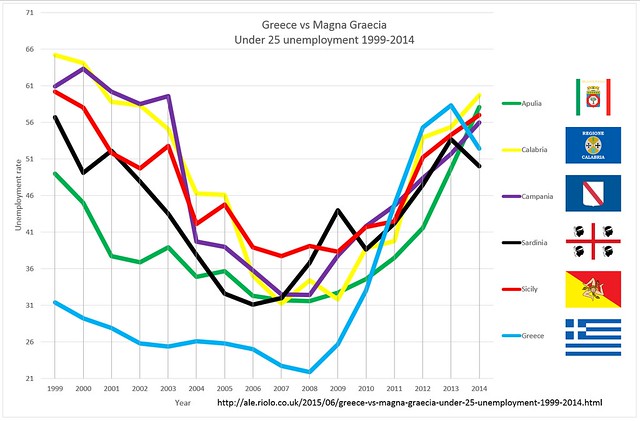
The Eurostat data used in the diagram above can be found in the "Unemployment rates by sex, age and NUTS 2 regions (%)" dataset (lfst_r_lfu3rt).
Greece vs Magna Graecia economic inactivity rates 1999-2014
Compared with the poorer third of Italy, Greece wouldn't appear to have such a big inactivity issue. Actually, the inactivity rate for the over 15 under 64 population appears to have slightly decreased in recent years:
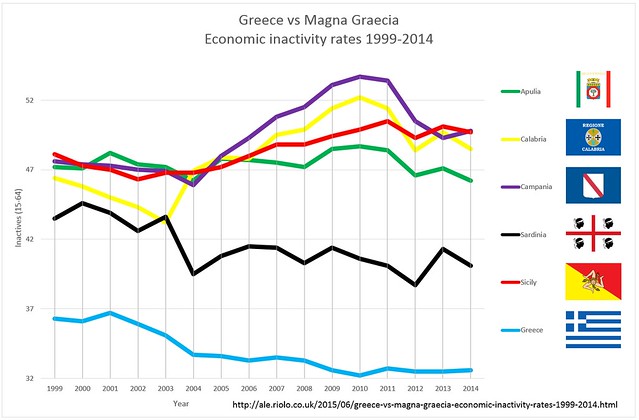
The Eurostat data used in the diagram above can be found in the "Economic activity rates by sex, age and NUTS 2 regions (%)" dataset (lfst_r_lfp2actrt).
Monday, 29 June 2015
Greece vs Magna Graecia GDP PPS 2000-2013
If Greece will default on its public debt in the next weeks, and the Italian government will ask its Southern states to contribute with more cuts and new taxes to the attempt to cover the gargantuan €65 billion Euros black hole that default may potentially leave on its public accounts, this will be a textbook case of stealing from the poor after giving to the rich:
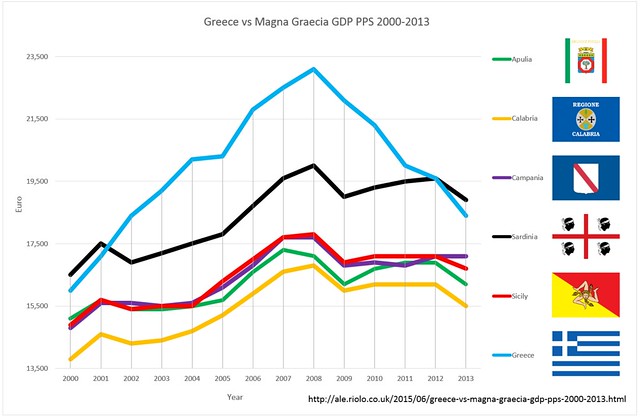
Note: to compile the diagram above I had to combine the Eurostat "Regional gross domestic product by NUTS 2 regions", a series ending in 2011, with the more recent Istat "Prodotto interno lordo lato produzione", which was published after the introduction of ESA 2010. This involved some fancy transformation including applying the Eurostat purchasing power parities indices on the last couple of years myself. Chances there are that when in a couple of years Eurostat will provide us with an ESA 2010 updated "Regional gross domestic product by NUTS 2 regions" series, I'll have to review the diagram above, but we should not expect its core message to change.
P.S.: the title of the diagram and of the article is a simplification: Sardinia, like Abruzzi or Molise, was never considered part of Magna Graecia, but I did add one and left out the other two. Also, I didn't forget Basilicata, which instead was quite central to the concept of Magna Graecia, but the diagram was already pretty complex, so I decided to leave it out. Basilicata would have fared somewhere half way between Sardinia and Sicily.
P.S.: the title of the diagram and of the article is a simplification: Sardinia, like Abruzzi or Molise, was never considered part of Magna Graecia, but I did add one and left out the other two. Also, I didn't forget Basilicata, which instead was quite central to the concept of Magna Graecia, but the diagram was already pretty complex, so I decided to leave it out. Basilicata would have fared somewhere half way between Sardinia and Sicily.
Subscribe to:
Posts (Atom)